

National Recycling Week 2026: what goes in the yellow bin, and where the tricky items go
The yellow bin's no list is longer than its yes list
| Yes, loose and rinsed | No |
|---|---|
|
|
| Willoughby Council's list. Rules vary by council: check yours. | |
Source: Willoughby Council; NSW Environment Protection Authority
National Recycling Week runs 9 to 15 November 2026, and the most useful thing you can do that week costs nothing: put the right things in the yellow bin and keep the wrong ones out.
Here is the surprise. Willoughby Council's recycling bin page lists nine kinds of things that belong in the yellow bin and fifteen that don't. The point it makes is simple: knowing the no list matters as much as knowing the yes list.
The yes list is short and easy to remember. Rigid plastic containers from the kitchen, bathroom and laundry, glass bottles and jars, aluminium and steel cans, milk cartons, Tetra Paks and poppers, aerosol cans, paper and cardboard, and clean, clear meat trays. Give containers a rinse first.
One caution before you stick this on the fridge. In NSW, kerbside recycling is run by local councils and what's accepted varies from council to council. We use Willoughby's lists as the worked example. If you live in another council area, such as Lane Cove, check your own council's list before you rely on this one.
Where it all goes once it leaves your kitchen
Source: Willoughby Council, recycling bin; NSW EPA, Return and Earn; Willoughby Council, soft plastics; NSW EPA, household recycling
Your yellow bin is only one of six routes out of the house. Picture your kitchen bench with a path running from it to each destination.
The yellow bin's path is the one you never see. In Willoughby, recycling goes to Kimbriki in Ingleside, then to iQRenew's sorting facility. The bin has an 80 kg weight limit.
The other five routes take what the bin can't, or what's worth a refund: refundable drink containers, soft plastics, batteries and problem waste, household chemicals, and medicines. Each has its own section below.
Soft plastics and bagged recycling: the yellow bin's biggest no
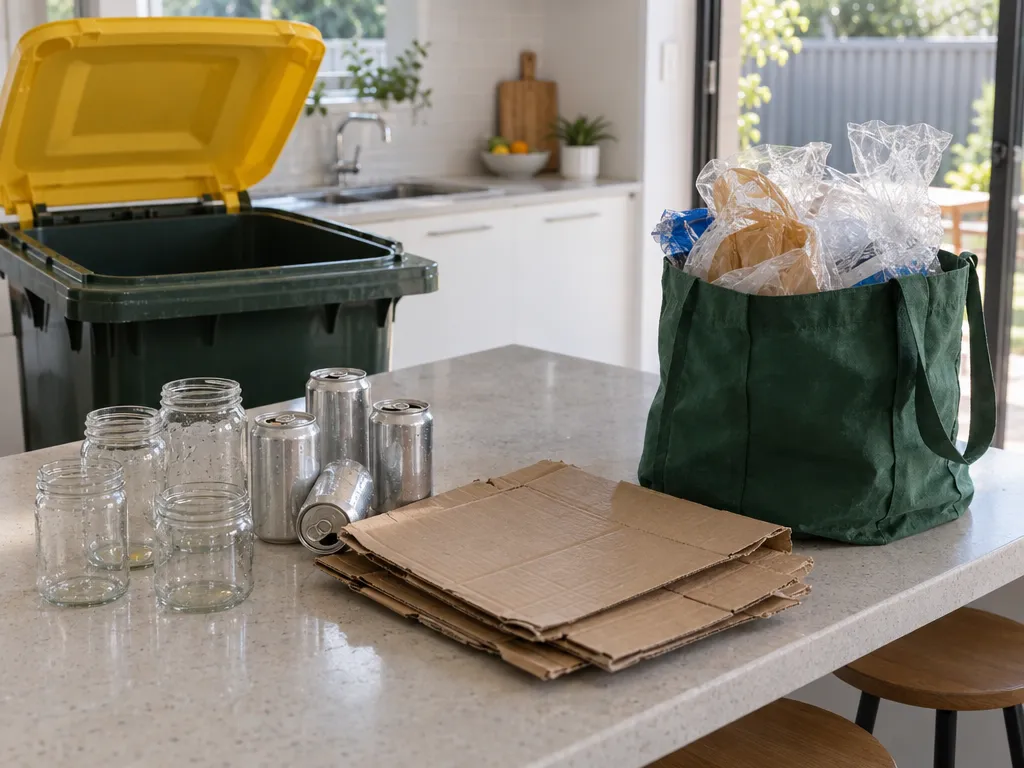
Soft plastics such as bread bags, frozen food bags, wrap and chip packets don't go in the yellow bin, because they jam sorting machines.
The same goes for the bag you carry your recycling out in. Plastic bags, soft plastics and bagged recycling are all on the no list, along with bubble wrap. Tip everything in loose.
So where do soft plastics go? Unless you drop them off, Willoughby says they go in the red bin. You do have two other options. A supermarket drop-off trial resumed from the end of June 2025, and the council stresses it is still a trial, because the capacity to recycle all soft plastics isn't there yet. The council also lists free doorstep pick-up through HomeCycle.
Nationally, Soft Plastics Stewardship Australia reports over 700 collection points, giving access to almost 70% of Australians. Its kerbside trials ran in nine councils in NSW, SA and VIC, and Willoughby wasn't one of them. For now, soft plastics stay out of the yellow bin here.
The other wrong-bin regulars
Some items look like recycling and aren't. On Willoughby's list, these stay out of the yellow bin: disposable coffee cups and lids, polystyrene, shredded paper, dark meat trays, plastic toys, wax-coated fruit boxes, and pizza boxes unless they're clean.
Glass is the one that catches people out. Bottles and jars are fine. Window or mirror glass, drinking glasses and crockery are not.
Two more items on the no list, light bulbs and paint tins, have a free drop-off of their own. The batteries and paint section below covers it.
The numbers in the triangle don't mean recyclable
Australasian Recycling Label
Black recycling symbol
Recyclable as is, place each piece separately
White recycling symbol
Conditional: follow the instructions, or it goes in general waste
Bin symbol
Not recyclable
Geotag
Check locally
Plastic Identification Code: not a recycling label
The numbers 1 to 7 inside a triangle of arrows are Plastic Identification Codes, and they don't mean an item can be recycled.
The label worth reading is the Australasian Recycling Label, and it has four classifications:
- Black recycling symbol: recyclable as is. Place each piece in the bin separately.
- White recycling symbol: conditional. Follow the instructions printed with it, or the item goes in general waste.
- Bin symbol: not recyclable.
- Geotag: check locally.
A yoghurt tub with a black symbol on the tub and a white one on the foil lid is two decisions, not one.
Drink containers: Return and Earn or the yellow bin?
| Return and Earn | Yellow bin instead |
|---|---|
|
|
Source: NSW EPA, Return and Earn
Some of your recycling is worth money. Return and Earn pays a refund on each eligible drink container, from 150mL to 3L, at over 600 NSW return points. Look for the refund mark, and bring containers empty, uncrushed, unbroken and still labelled. Crushing cans to save space can cost you the refund.
Not every drink container qualifies. Milk containers, glass wine and spirit bottles, juice bottles of 1L or more and cordial bottles aren't eligible, so they go in the yellow bin.
If the refund isn't the point for you, a Return and Earn machine lets you donate it to a partner charity, school or community group. The EPA says the scheme has cut drink container litter volume by 73% and recycled over one million tonnes since 2017.
Batteries, paint, gas and medicines never go in a bin
| Item | Where it goes | Note |
|---|---|---|
| Household batteries | Northern Sydney CRC or a B-cycle point (Aldi, JB Hi-Fi, Coles, Bunnings) | Tape the terminals with clear sticky tape |
| Leaking or damaged batteries | CRC or Household Chemical CleanOut only | In a clear bag or container; never a retail point |
| Lead-acid and car batteries | CRC | |
| Vapes, e-bikes, e-scooters, headphones | Northern Sydney CRC | |
| Paint, gas bottles, fire extinguishers, motor and cooking oils, fluoro tubes and globes, smoke detectors | CRC | Free year-round |
| Cleaners, pool and hobby chemicals, pesticides | Household Chemical CleanOut | Set dates |
| Unwanted medicines | Any pharmacy, ReturnMed | Free |
Source: Willoughby Council, e-waste and batteries; NSW EPA, household recycling
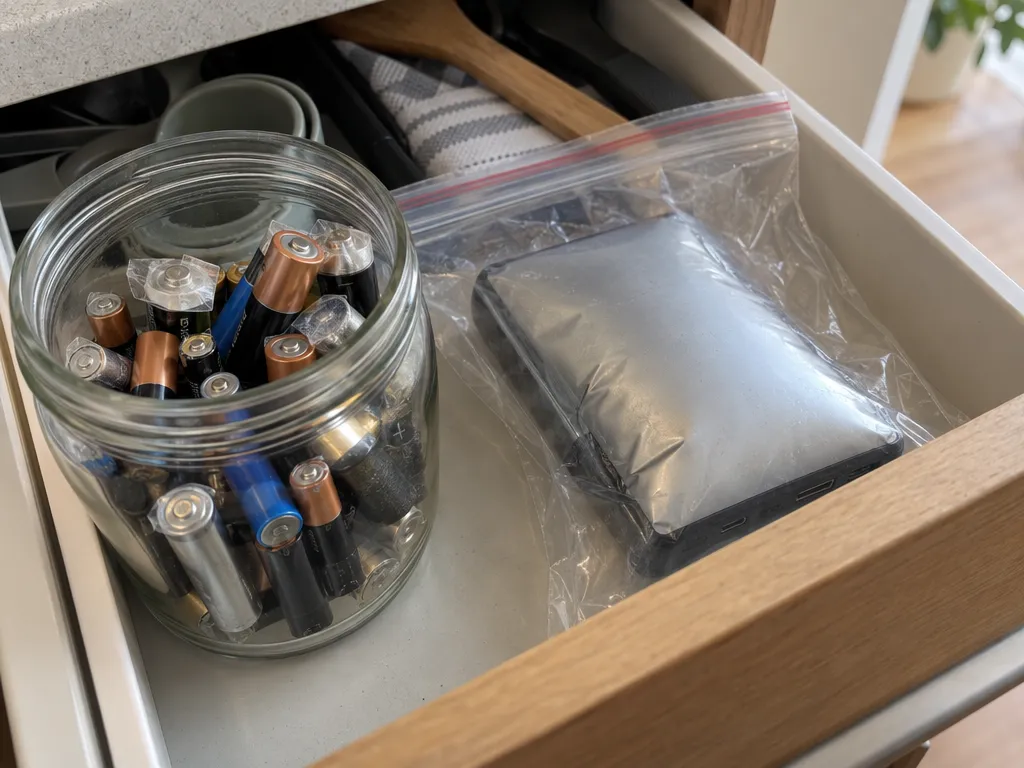
This is the section that matters for safety. Batteries and e-waste are not allowed in any bin or bulky waste pile, because they cause fires if crushed in waste trucks or at waste facilities.
Before you store or drop off batteries, tape the terminals with clear sticky tape. Put leaking or damaged batteries in a clear plastic bag or container and take them to a Community Recycling Centre (CRC) or a Household Chemical CleanOut. Never take a damaged battery to a retail collection point.
Where the good ones go:
- The Northern Sydney CRC takes household and lead-acid batteries, plus items with batteries built in, such as vapes, e-bikes, e-scooters and headphones.
- B-cycle points, including Aldi, JB Hi-Fi, Coles and Bunnings, take household batteries only.
CRCs take much more than batteries. NSW CRCs are free year-round drop-offs for paint, gas bottles, fire extinguishers, motor and cooking oils, car and household batteries, fluoro tubes and globes, and smoke detectors. Cleaners, pool and hobby chemicals and pesticides go to Household Chemical CleanOut events on set dates.
Old medicines are the easiest of the lot. Unwanted medicines go free to any pharmacy through ReturnMed.
One more for anyone with ageing rooftop panels. NSW's draft solar panels regulation is open for public consultation until 5pm Monday 16 November 2026, and the scheme is expected to start in early 2028 once finalised.
Sorting it while you clear out
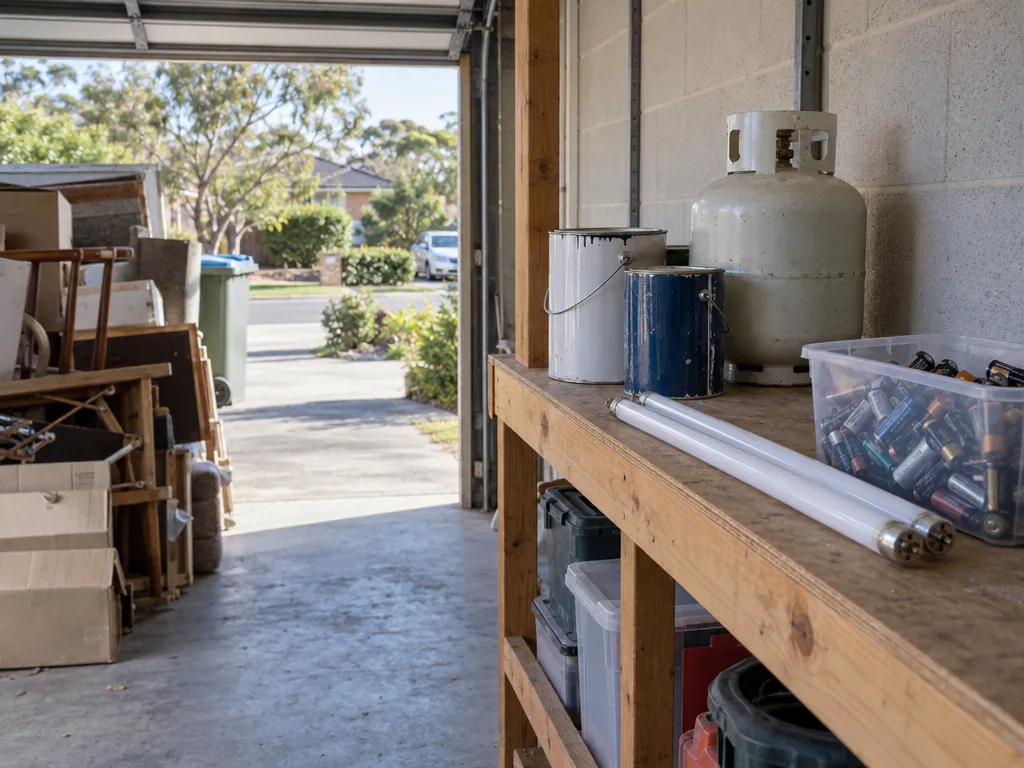
A big clear-out is when bin mistakes multiply, because everything leaves the house at once. A simple rule for any clear-out: pull the hazardous items out first. Batteries, paint, gas bottles, fluoros, chemicals and medicines go on a shelf of their own before anything else moves.
After that, work through the routes in this order: things worth selling or giving away, refundable containers, yellow-bin recycling, and only then general waste. Our Garage Sale Trail sorting guide covers the sell and donate side. Old TVs, computers and printers have their own free scheme, explained in our e-waste recycling guide. If you're planning to put things out for collection, our council clean-up guide explains how bulky waste works, and batteries and e-waste stay off that pile too.
Moving somewhere smaller? Stays and Goes walks you through the sort room by room.
What National Recycling Week is, and how far Australia has come
Source: Planet Ark, Recycling Near You
Planet Ark established National Recycling Week in 1996 and holds it every year in the second week of November. If a page you find still shows last year's dates, go by 9 to 15 November 2026.
The long view is striking. Planet Ark says Australia's recycling rate has gone from 7% (1.5 million tonnes) in 1996 to over 60% (43 million tonnes). Per person, that is about 80kg a year then and about 1,700kg now. By our estimate, that is roughly 21 times as much material per person (1,700 divided by 80 is about 21).
For old TVs and computers, the federal environment department points to Recycling Near You, Recycle Mate or your local council to find a drop-off.
The cheat sheet, bin by bin
Yellow bin
loose and rinsed, 80 kg limit (Willoughby)
Source: Willoughby Council
Return and Earn
a refund on each eligible container, 150 mL to 3 L
Source: NSW EPA
Soft plastics
not the yellow bin: supermarket drop-off trial or HomeCycle
Source: Willoughby Council
Batteries
tape terminals; CRC or B-cycle; damaged to CRC or CleanOut only
Source: Willoughby Council
Paint, gas, fluoros, smoke detectors
Community Recycling Centre, free
Source: NSW EPA
Medicines
any pharmacy, ReturnMed
Source: NSW EPA
National Recycling Week: 9 to 15 November 2026Source: Planet Ark, Recycling Near You
- Yellow bin: loose, rinsed containers, paper and cardboard, with an 80 kg limit in Willoughby.
- Return and Earn: a refund on each eligible container, 150mL to 3L.
- Soft plastics: not the yellow bin. Use the supermarket drop-off trial or HomeCycle.
- Batteries: tape the terminals, then take them to a CRC or B-cycle point. Damaged batteries go to a CRC or CleanOut only.
- Paint, gas, fluoros, smoke detectors: a Community Recycling Centre, free.
- Medicines: any pharmacy, through ReturnMed.
When the pile is bigger than your bins
Most weeks, the yellow bin and a couple of drop-offs are all you need. A downsize, a move or a garage that hasn't been touched in years is different. Once you've set the hazardous items aside and sorted what's worth keeping, tell Carry Forward what's left and ask for a quote.
Sources
- https://recyclingnearyou.com.au/nationalrecyclingweek
- https://www.epa.nsw.gov.au/Your-environment/Recycling-and-reuse/household-recycling-overview
- https://www.willoughby.nsw.gov.au/Residents/Waste-and-recycling/Household-bin-services/Recycling-bin
- https://www.willoughby.nsw.gov.au/Residents/Waste-and-recycling/FAQs-and-other-resources/A-Z-of-recycling/Plastics-soft-packaging
- https://spsa.au/collection-locations/
- https://www.willoughby.nsw.gov.au/Residents/Waste-and-recycling/FAQs-and-other-resources/Understanding-the-ARL
- https://www.epa.nsw.gov.au/Your-environment/Recycling-and-reuse/Return-and-earn
- https://www.willoughby.nsw.gov.au/Residents/Waste-and-recycling/Drop-off-and-home-collection-recycling/E-waste-and-batteries
- https://yoursay.epa.nsw.gov.au/draft-solar-panels-regulation
- https://www.dcceew.gov.au/environment/protection/waste/product-stewardship/products-schemes/television-computer-recycling-scheme/households
Pictures in this guide are illustrations, not photos of our jobs.
Tell us what goes. We do the rest.
Send the form and we ring you back to arrange a look at the job. The price is fixed on sight, agreed before we lift a thing, and it covers the lifting, the loading, the sweep-up and the disposal.
- One fixed price, agreed before we start. No hourly rate, no tip fees added later.
- One visit for most jobs, booked at a time that suits your building or your street.
- Worthwhile things offered for donation first. Regulated streams go to licensed facilities.
Enquiries through this form are the fastest way to reach us while our phone line is being set up. We call you back.