

Clearing bulky items from a Lower North Shore apartment tower: lifts, docks and who to ask
If you live in a Chatswood, St Leonards or Artarmon tower, the council's collection starts at the kerb. Every metre between your front door and the kerb runs on your building's rules.
Put Willoughby Council's two free services side by side and the gap is plain:
- The bulky clean-up wants items out on the nature strip from Sunday night of the collection week, labelled.
- The booked mattress collection is kerbside only, and its drivers cannot enter premises.
Neither comes up in the lift. So the order is building first, kerb second. Carry Forward's advice is to make the building manager your first call, before you book anything with the council or anyone else.
The council details below come from its pages as archived in December 2025, and May 2025 for booking. Check the council's current page, or call 9777 1000, before you book.
Who decides how big items leave your building?
Unit, corridor and lift
Your scheme's by-laws (each scheme's differ)
Lift and dock
Building manager, generally the primary contact for contractors (not every scheme has one: then the strata manager or committee secretary)
Kerb
- Willoughby bulky clean-up: labelled, within 2 m³ per collection, two-person lift, items no longer than 2 m, though the same page's FAQ says 1 metre, so confirm with council for anything long
- Soft Landing mattress collection: kerbside only, up to 4 per booking, drivers cannot enter premises
Sources: NSW Government, strata by-laws; NSW Government, Who's who in strata; Willoughby City Council, Kerbside bulky waste clean-up collections (archived copy); Willoughby City Council, Booked mattress collections (archived copy)
Your owners corporation does, through its by-laws and the people who run the building day to day. By-laws are rules every resident of a strata scheme must follow, and each scheme's differ. Lift bookings, loading dock times and any move bond are your building's own arrangements. Expect a different answer in each tower, even between two on the same street.
The person to ask is usually the building manager. The NSW Government's Who's who in strata guide says building managers look after common property, including taking out bins and recycling. They also manage access for tradespeople and non-residents, and they are "generally the primary contact for contractors working on-site".
Not every building has one. A scheme does not have to have a building manager or a strata manager. Where there is a strata manager, they are often an owner's main contact. If you don't know who anyone is, the strata roll has contact details.
Ask four questions, and get the answers in writing:
- How is the lift booked?
- When can the dock or loading area be used?
- Does the lift need protecting?
- What does the building want from any contractor who comes on site?
Where do you get a copy of the by-laws?
| If you are... | Where the rules come from |
|---|---|
| Owner | A copy of the by-laws from the strata committee secretary or strata manager |
| Tenant | The same, and your agent or landlord must give you a copy before the lease is signed |
| Tenant in a mixed-use building (shops or offices below) | Also the management statement, which your agent must hand over within 14 days of signing the lease |
| Not sure who anyone is | The strata roll has contact details |
Sources: NSW Government, strata by-laws; NSW Government, Who's who in strata
Owners and tenants can get a copy from the strata committee secretary or strata manager. If you rent, your agent or landlord must give you a copy before the lease is signed, so check your lease paperwork first. Your property manager handles the lease. The building manager handles the building.
Mixed-use buildings, with shops or offices below, have a second document. A management statement sets further rules on shared facilities, and a tenant's agent must hand over a copy within 14 days of signing the lease.
If a by-law is breached, the usual steps are a warning, then a notice to comply, then mediation, then the Tribunal. The fines are covered below.
What will Willoughby's kerbside clean-up take?
Willoughby kerbside bulky clean-up, per council's page archived 3 Dec 2025: check the current page
Collected
- Furniture
- Small appliances
- Soft furnishings
- Whitegoods
- Carpet cut into 1 m lengths and bundled
Not collected
- Mattresses and ensemble bases (separate service from 1 August 2025)
- TVs and computers
- Mirrors and sheet glass
- Polystyrene
- Building materials
- Paint and liquids
- Cardboard
- Small household items
- Gas bottles
- Asbestos
- Tyres and car parts
- General household waste
Limits: 2 m³ per collection, only items two people can lift safely, items no longer than 2 m, though the same page's FAQ says 1 metre, so confirm with council for anything long.
Source: Willoughby City Council, Kerbside bulky waste clean-up collections (archived copy)
The booking rules are covered in our guide to Willoughby Council bulky waste clean-ups. Here is what matters from a tower.
Council's kerbside bulky waste clean-up page sets these limits:
- It takes furniture, small appliances, soft furnishings, whitegoods and carpet cut into 1 m lengths and bundled.
- It allows up to 2 m³ per collection.
- No item can be longer than 2 m, though the same page's FAQ says 1 metre, so confirm with council for anything long.
- Crews only lift items two people can lift safely.
A three-seater couch can be close to that length limit, so measure before you plan around it.
The same page lists what the service won't take, including mattresses and ensemble bases, TVs and computers, mirrors and sheet glass, polystyrene, building materials, paint and liquids, cardboard, small household items and gas bottles. A flat clear-out tends to throw up several of them.
Entitlement is set per eligible property: one free booked clean-up and three free scheduled clean-ups a year. The page doesn't say how a building of many units is counted, so confirm with council before you rely on a free booking. The council also points apartment residents to its own waste and recycling resources for apartments.
Timing matters. The May 2025 version of the booking page said bookings must be made at least a week ahead and recommended booking at least one month ahead. Council's clean-up page says cancelling inside 7 days loses the free booking until the next calendar year. The pre-booked label must show the address and booking reference.
In a tower, that nature strip is shared with everyone else in the building. Agree with the building manager where your pile can stand. Don't add to anyone else's pile: council's page calls adding items to other people's piles illegal dumping.
One more reason to sort first: council says most collected material goes to landfill. Anything still good is worth trying to sell or donate first. Our sell, donate, clear guide and Stays and Goes can help with that sort.
Where do mattresses, TVs and chemicals go instead?
Mixed items
- 1
Mattresses and fabric-covered ensemble bases
The free booked Soft Landing collection: up to 4 per booking, kerbside only, out by 6am, labelled on both sides; bed frames, slat and drawer bases are not taken.
- 2
TVs and computers
E-waste recycling, not the bulky clean-up.
- 3
Household chemicals
A free Chemical CleanOut event or the Community Recycling Centre in Artarmon.
- 4
Furniture, small appliances, soft furnishings, whitegoods and carpet cut into 1 m lengths and bundled
The bulky clean-up, within its limits.
Sources: Willoughby City Council, Booked mattress collections (archived copy); Willoughby City Council, Kerbside bulky waste clean-up collections (archived copy)
Mattresses. Since 1 August 2025, mattresses have left the bulky clean-up for a separate service. The booked mattress collection is free, is run with Soft Landing, and takes up to four mattresses or ensemble bases per booking. Items must be at the kerb by 6am on the day, labelled on both sides. Bed frames, slat or drawer bases and other furniture are not taken. That means a bed usually leaves the building in two parts, on two different days.
TVs and computers. These go to e-waste recycling, not the bulky clean-up. Our guide to e-waste recycling in NSW covers where.
Chemicals. For household chemicals, council's page points to free Chemical CleanOut events or the Community Recycling Centre in Artarmon.
Building materials. These are covered in the renovation section below.
Why shouldn't anything wait in the bin room, the dock or a corridor?
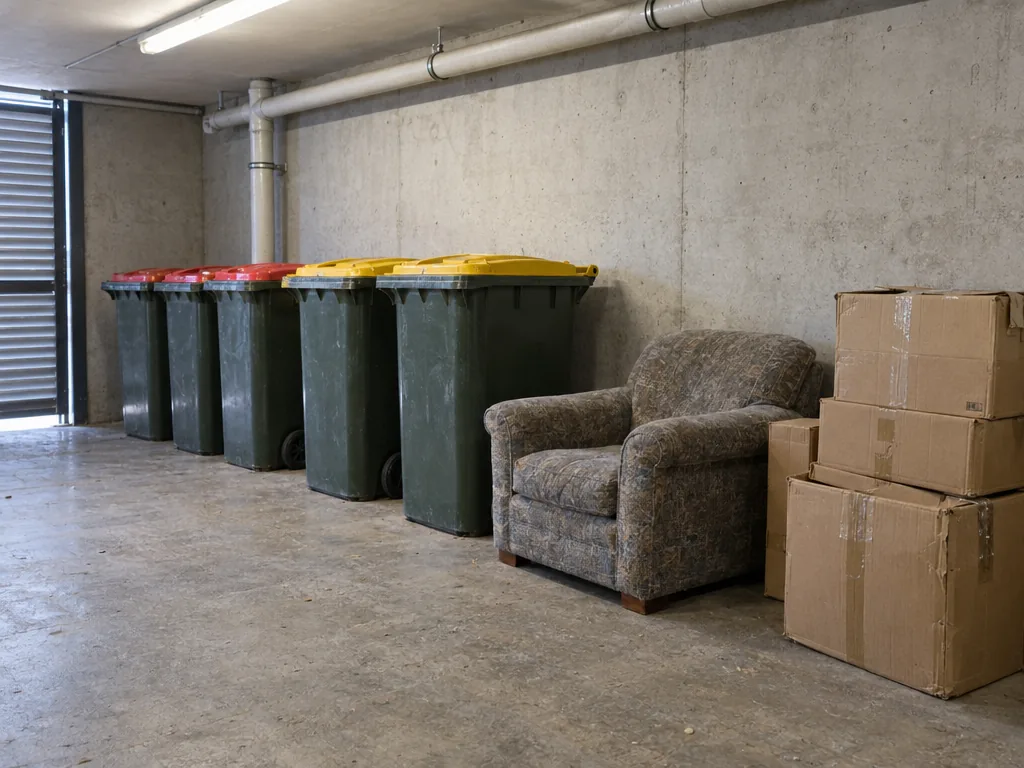
Because those spaces are common property, and someone else has to deal with whatever you leave. Building managers manage common property, including taking out bins and recycling. A wardrobe parked beside the bins becomes their problem, then the owners corporation's.
Whether it breaches your by-laws depends on what your scheme's by-laws say. Where a breach does reach the Tribunal, the NSW Civil and Administrative Tribunal can fine up to $1,100, then up to $2,200 for a continuing breach, and up to $5,500 if an earlier order was ignored (checked November 2026).
NSW Civil and Administrative Tribunal's maximum fines for a strata by-law breach
Out on the street, state law takes over. The NSW EPA says depositing more than 50 L or 50 kg of waste in a public place or open private place is an offence. The on-the-spot fines are $1,000 for individuals, or $2,500 in a "sensitive place" (checked November 2026).
The same page says the owner of the waste, the transporter and the receiver can each be committing an offence. Handing a load to someone else doesn't end your interest in where it lands. Ask anyone you hire where it goes. Our page on where things actually go after a clearance is a useful starting point.
What happens to things someone else leaves behind?
NSW abandoned-goods tiers for owners corporations
Rubbish, food or plants
No notice needed
Goods worth under $1,000
Notice (written or verbal), wait at least 14 days
Personal documents
Written notice, wait at least 28 days
Goods worth $1,000 to $20,000
Written notice, wait at least 28 days, then public auction or private sale
Goods worth over $20,000
Tribunal order needed
For goods inside a lot, the owners corporation must also seek the lot owner's consent first.
A building cannot always bin whatever is left behind: under NSW's abandoned goods rules, only rubbish, food or plants need no notice.
Everything else follows a ladder set by what the goods are and what they are worth. The value bands below are the NSW Government's (checked November 2026).
- Personal documents: written notice and a 28-day wait.
- Goods worth under $1,000: notice, written or verbal, and at least 14 days (checked November 2026).
- Goods worth $1,000 to $20,000: written notice, at least 28 days, then public auction or private sale (checked November 2026).
- Goods worth over $20,000: a Tribunal order (checked November 2026).
Goods can be abandoned on common property or inside a lot. If they are inside a lot, the owners corporation must also seek the lot owner's consent first.
A disposal notice must:
- describe the goods
- say where to collect them
- state any removal or storage costs
- give the date after which they will be sold or destroyed.
For residents, the lesson runs the other way. Anything of yours sitting on common property can end up in this process. Move it on before it does.
What if a renovation is behind the clear-out?
| Type of work | Approval in NSW strata |
|---|---|
| Cosmetic work | No approval needed |
| Minor renovation | Owners corporation or committee approval |
| Major renovation | Special resolution (no more than 25% of votes against) |
Renovations produce the biggest piles, and the approval comes before the skip. Under NSW strata rules:
- cosmetic work does not need approval
- minor renovations need owners corporation or committee approval
- a major renovation needs a special resolution, with no more than 25% of votes against.
Plan the debris early. Building materials are on the council's not-collected list. Old fittings and offcuts need their own route, such as a renovation clear-out, and the same lift and dock questions apply.
How do you plan the carry from door to kerb?
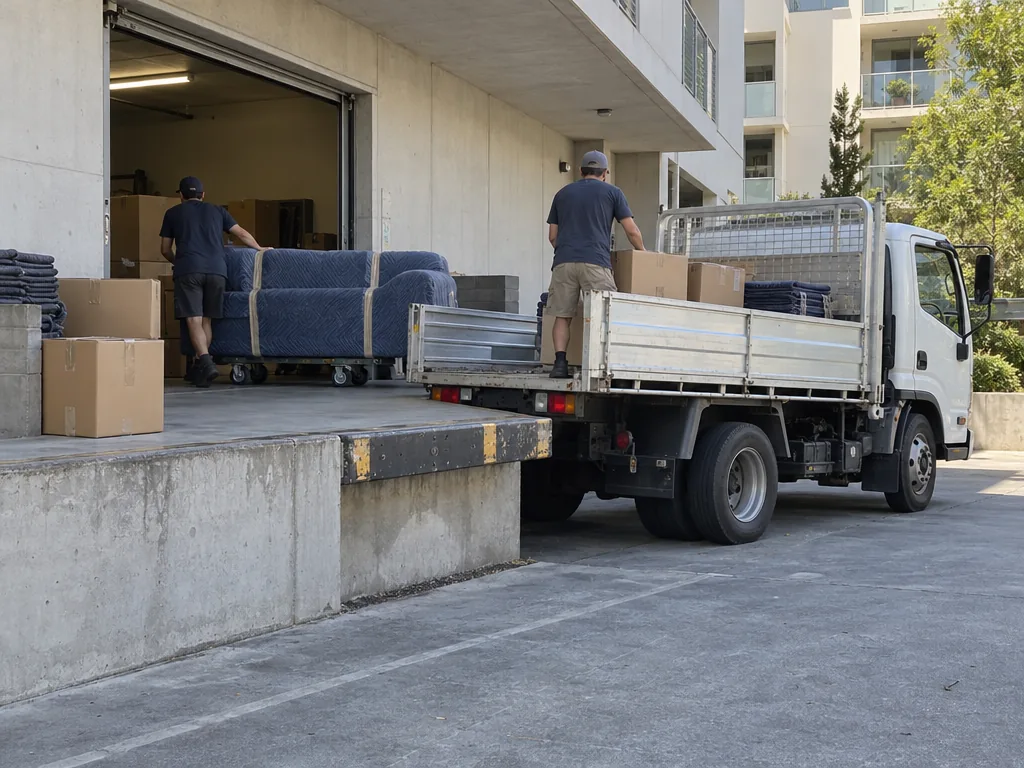
Treat it as one job with several destinations, and do the measuring before anyone lifts.
- Measure three things: the inside of the lift car, every doorway and corridor turn on the way, and your longest item. A sofa that fits through the front door can still jam on a corridor corner.
- Sort by where each item ends up, not by room. One group is for the bulky clean-up, within its limits. One is for the mattress booking. One is for e-waste, one for chemicals, and one for sell or donate.
- Book the lift for the whole job, so each group goes down in as few trips as possible and nothing waits in the lobby.
- Match the kerb dates to the building. If your clean-up items go out on a Sunday night and the mattress is out by 6am on another day, make sure the building knows both.
Executors face the same carry with extra paperwork. Start with the strata roll for contacts, and see our page on deceased estate clearance. Tenants clearing before they leave should get the by-laws from their agent and keep the property manager in the loop.
Sources: NSW Government, Who's who in strata; NSW Government, strata by-laws; Willoughby City Council, Kerbside bulky waste clean-up collections (archived copy); Willoughby City Council, Booked mattress collections (archived copy)
Your tower clear-out on one page
The building
- By-laws differ by scheme
- The building manager is generally the primary contact for contractors
- Tribunal fine for a first by-law breach up to $1,100, continuing breach up to $2,200, earlier order ignored up to $5,500 (checked November 2026)
The kerb
- Willoughby kerbside limit 2 m³ per collection, items no longer than 2 m, though the same page's FAQ says 1 metre, so confirm with council for anything long
- Mattress collection cap 4 items per booking (council pages archived Dec 2025)
Left behind
- Abandoned goods under $1,000, notify, wait at least 14 days
- $1,000 to $20,000, written notice, wait at least 28 days
- Over $20,000, Tribunal order
The building sets the path, the council collects only at the kerb, and anything left in between is handled under rules that take weeks. Keep this summary handy for the week of the move.
Ready to hand over the carrying?
Start with your building manager and get the lift and dock arrangements in writing. Then decide what goes to the council, what goes to the mattress booking and what needs another route.
If you'd rather someone else did the lifting and the sorting, ask Carry Forward for a quote through the Get a Fixed-Price Quote page. Tell us the building, the floor, what's going and what the building manager has asked for. For one or two pieces, see single item pickups. For a whole flat, see apartment rubbish pickups.
Sources
- https://www.nsw.gov.au/housing-and-construction/strata/living/by-laws
- https://www.nsw.gov.au/housing-and-construction/strata/roles
- https://www.nsw.gov.au/housing-and-construction/strata/living/abandoned-goods
- https://www.nsw.gov.au/housing-and-construction/strata/living/renovations
- https://www.epa.nsw.gov.au/Your-environment/Illegal-dumping/illegal-dumping-laws-penalties
- https://web.archive.org/web/20251203112425/https://www.willoughby.nsw.gov.au/Residents/Waste-and-recycling/Kerbside-bulky-waste-clean-up-collections
- https://web.archive.org/web/20251203112455/https://www.willoughby.nsw.gov.au/Residents/Waste-and-recycling/Booked-mattress-collections
- https://web.archive.org/web/20250513041713/https://www.willoughby.nsw.gov.au/Residents/Waste-and-recycling/Kerbside-bulky-waste-clean-up-collections/Book-a-bulky-waste-collection
Pictures in this guide are illustrations, not photos of our jobs.
Tell us what goes. We do the rest.
Send the form and we ring you back to arrange a look at the job. The price is fixed on sight, agreed before we lift a thing, and it covers the lifting, the loading, the sweep-up and the disposal.
- One fixed price, agreed before we start. No hourly rate, no tip fees added later.
- One visit for most jobs, booked at a time that suits your building or your street.
- Worthwhile things offered for donation first. Regulated streams go to licensed facilities.
Enquiries through this form are the fastest way to reach us while our phone line is being set up. We call you back.